The moon will be 100% full Tuesday, August 24, 2010 at 10:05 A.M. Las Vegas time.
From Western Washington University:
“American Indians gave names to each of the full moons to keep track of the passing year. The names are associated with the entire month until the next full moon occurs. Since a lunar month averages 29 days, the dates of the moons change from year to year. Here are titles most closely associated with calendar months.”
Back East Creek Children
Western Washington University
The Native American Creek (Southeast, Alabama, Georgia) refer to the August full moon as: “big ripening moon.” No name is given for the August moon in the Creek language. (Nor is there a name given for the tea-house.)
From The Old Farmer’s Almanac:
Full Sturgeon Moon
Some Native American tribes knew that the sturgeon of the Great Lakes and Lake Champlain were most readily caught during this full Moon. Others called it the Green Corn Moon or the Grain Moon.
Out West Hopi Children
Western Washington University
In the Hopi (Southwest, Arizona) language the name for August’s full moon is: “paamuya” or “moon of joyful.”
“With plans in the works for man to return to the Moon by 2020, what better time to review some Moon facts about our favorite celestial body?” Diameter: 2,160 miles
This is about the distance from Washington, D.C., to the Rocky Mountains. Average Orbital Speed: 2,287 miles per hour
This number is very close to the Moon’s diameter, making it the only known celestial body that moves through space at its own width per hour. This motion is readily visible from Earth, even to the naked eye, as the Moon shifts its position against the background stars. Synodic Period, or Lunar Month: 29 days, 12 hours, 44 minutes, 2.8 seconds
This is the average period from one new Moon to the next. read more from The Old Farmer’s Almanac
Some information is from Western Washington University and The Old Farmer’s Almanac.
Hello Linda…
I got to thinking (sorry ’bout that “got to”) and some thoughts came into being. I might be late to the table and if this has already happened, so be it. I’d like to, at least, plant a seed and see if it blossoms.
Here’s the deal: I don’t really have anything against customer support East Indians or customer support people from other foreign countries, but I probably have a bias for our Native American Indians. Long story short: Why aren’t we utilizing Native Americans on the Reservations for outsourced Customer Support for American companies?
In other words, why doesn’t Microsoft, Bill Gates etal step up to the plate and outsource Customer Support work to the Native American Reservation peoples. I’m not aiming an arrow at Bill Gates and Microsoft, just using that example for obvious reasons.
The computer companies etc. could pay for the training, the government could kick in a few bucks and the Native Casinos could provide a few grants. The loop stays within the USA. How could this not be a WIN-WIN .
I’m not so naive as to think that I have come up with a totally new idea, but regardless of who thought of it first, I think it’s an idea that has to get some Etime. Please pass it on if you agree.
New York times article from December 13, 2009 Gang Violence Grows on an Indian Reservation
PINE RIDGE, S.D. — Richard Wilson has been a pallbearer for at least five of his “homeboys” in the North Side Tre Tre Gangster Crips, a Sioux imitation of a notorious Denver gang.
One 15-year-old member was mauled by rivals. A 17-year-old shot himself; another, on a cocaine binge and firing wildly, was shot by the police. One died in a drunken car wreck, and another, a founder of the gang named Gaylord, was stabbed to death at 27. read more from the Times
THE PALLBEARER Richard Wilson, left, has carried the coffins of five gang members from Pine Ridge, S.D. At right, his half-brother, Richard Lame.
The photo of Chief Red Cloud was used to honor the past in general.
by Grocery Store at the Denver West / Central City KOA RV Park
Celebrating a birthday, four of us went up to Central City/Black Hawk to do a buffet and try our luck at the machines. On the drive up I-70, just before entering Central City – on Central City Parkway – we noticed that the *Gambler’s Edge RV Park was open for business after a year+ closure. Is this a small indicater that business is coming back to the mountain casinos? We’ll wait and see. I called the office and confirmed the reopening of the RV Park. The park reopened May 1, 2010. *It is now called the Denver West / Central City KOA RV Park.
First let me back up for a second. Last week I had an Asian Chicken Salad (a fav) at the Red Coral restaurant on So. Colorado Blvd. in Denver. I saw some coupons in an Asian magazine at the restaurant. One of the coupons was a two-for-one buffet coupon for The Isle Hotel/Casino’s Calypso’s Buffet. I got a couple of coupons for a trip to the mountains.
Yesterday we drove up at around three o’ clock in the afternoon. First I wanted to check out The Ameristar Hotel Casino to see if I had any comps coming so we parked at the free Ameristar Casino Hotel’s covered parking garage and went in. The ladies sat in front of a fireplace and had a cocktail, I went to check for comps and Gregg went to the machines. Three of us were back in front of the fireplace when a very animated Gregg rushed up waving a slot ticket. He had a ticket for $198.00. Not bad for small-time gamers. Working off a very small budget, *I also played “his” machine and stopped when I was around $75.00 up. Not bad at all considering that my “bankroll” was a $5.00 comp I got from Ameristar. I parlayed that five dollar bill into gambling money which I used for the rest of the night. Krissy also was ahead at Ameristar. This sounds like hype, but this was one of the best gambling nights any of us has ever had in Black Hawk. The crowd was lively, the band was hot and the casino was hoppin’. We were several hundred bucks ahead and the night was just starting.
After a bit more gambling we were all getting hungry so we moved the car to the Riviera’s parking garage, walked across the street to The Isle Hotel, refreshed our Player cards, put in a couple of bucks, then moved over to Calypso’s Buffet. I had seen this room before but had never eaten there. The basic design is “Island” with thached-roofs and bamboo, and some other stuff that doesn’t quite work, but that’s another post. Basically it’s a comfortable room. We took a booth against a wall on the oposite side of the buffet tables.
We were all somewhat surprised with the buffet. It was pretty decent, especially with the all-you-can-eat King Crab Legs (7 days.) My favorite – the peel and eat shrimp – were cold, firm and tasty. Also at the buffet tables: an (average) salad-bar with breads, soups and fruit, a build-your-own taco bar, an Asian food station, a carnivor station with roast beef, chicken etc. Some of the other tasty items were: risotto with sun-dried tomatoes, pizza, Swedish meatballs, Tuna Steaks, Bar-B-Que pork, Chicken Piccata, and of course the dessert station with gooey pies, cakes, ice cream and more.
Usually we do the buffet at The Ameristar or The Lodge Casino. We had coupons for The Isle, coupons rule…
After dinner we tasted a few machines at The ISLE then moved on over to The RIV, tried a few machines there then headed back to the city. It was indeed a good night.
Calypso’s Buffet
Isle Casino Hotel Black Hawk
401 Main Street
Black Hawk, CO 80422
*I debated whether or not to divulge the following information. I guess I decided to do just that. The killer machine was a [$0.01 – information was deleted august 10, 2010.]
*This information is for professional gamblers and not intended to entice persons to gamble. Although we did ok playing this machine, it could have been a fluke. We are not advising anyone to play this machine or any other gambling machine.
Help Us Stop the Tuscarora Roundup
Young foals will be run in high heat over rugged, rocky ground without public oversight
Please read the following press release and share with your local news station and any major news outlet you’d like to cover this story- this is yet another example of the cruel mismanagement of the BLM and it is unacceptable. Call on your Senators to pass your concerns onto Senators Reid and Ensign of Nevada. Thank you.
BLM Helicopter Roundup To Begin Despite Presence of Vulnerable Young Foals
BLM violates protocol designed to protect wild horse babies
……………………………………………………………………………………………………………………………….
Elko, NV (July 8, 2010)— Over 1,400 federally-protected wild mustangs are to be rounded up beginning tomorrow, July 9, in the Tuscarora area of Elko County Nevada during the hottest month of the year. The Bureau of Land Management (BLM) is violating their own set-protocol for waiting six weeks after the main foaling season, defined as March 1-June 30, so that young foals can escape the inherent danger of a high-heat summer roundup. BLM will dispatch privately contracted choppers to run the Tuscarora mustangs over miles of rugged terrain in a taxpayer-funded roundup expected to last three weeks and result in the removal of some 1,100 mustangs. Only last month, Oregon BLM wild horse managers postponed a planned roundup that would have started the day after foaling season—opting to begin instead in mid-August for the horses’ safety.
“If allowed to go forward this will be a massacre,” states Anne-Marie Pinter who rode the Pony Express Race through the area on her Spanish Mustang and saw small foals. “It is covered with razor-sharp, volcanic rock that will rip up the feet of these poor foals. Before riding the area, our event veterinarian strongly recommended that we put thick rubber boots over the metal shoes of our horses—the rocks are that treacherous. We experienced triple digit temperatures and had to constantly work at keeping our horses hydrated. I can’t even imagine the toll on terrified small foals and even the adult animals at the hottest time of the year. This amounts to horrible animal cruelty and no one will know what is going on because BLM has closed the area, even the roads.”
Last winter, during the deadliest BLM roundup in memory in the Calico Mountains of Northwestern Nevada, at least two 6-9 month foals suffered a horrible death. Their hooves literally separated from their leg bones after running over similar terrain. Yet, BLM justified the dead-of-winter roundup by stating in their Environment Assessment: “Fall and winter time-frames are much less stressful to foals than summer gathers. Not only are young foals in summer months more prone to dehydration and complications from heat stress, the handling, sorting and transport is a stress to the young animals and increases the chance for them to be rejected by their mothers. By gathering wild horses during the winter, stress associated with summer gathers can be avoided.”
BLM photo of Calico Roundup by Kurt Golgart
“Let’s be honest. What is driving these roundups has very little to do with concern for vulnerable foals and everything to do with contractor availability and using up taxpayer money before the end of fiscal year 2010,” states Cloud Foundation Director, Ginger Kathrens, who has spent over 16 years documenting the lives of wild horse families. “With only two helicopter contractors available to round up the horses, scheduling becomes tricky, especially when the goal is the removal of 6,000 wild horses before the end of September. So, the rush to rid the land of mustangs trumps humane treatment. Disgusting.”
The Cloud Foundation is asking that humane observers and the public be allowed to document the roundup and any injuries and deaths which occur. Currently BLM has arranged for a near total lockdown of roundup activities, including a widespread closure of public roads around the area. Access will be extremely limited despite promises made by top BLM officials to the contrary.
“Having a ‘media day’ during the operation is certainly not the same as having humane observers on site at all times during the operation,” says Elyse Gardner, who has documented the Pryor and Calico roundups. “A sanitized version of BLM activities is not transparency in dealing with the public’s horses. If anything, rather than transparency, BLM is closing the door on public observation because of what our cameras have already revealed about these roundups.”
Tuscarora horses including young foals, photo by Craig Downer, June 2010
If allowed to proceed, the Tuscarora roundup will decimate three herds, Owyhee, Little Humboldt and Rock Creek, living in a vast 455,000-acre area about 90 miles northwest of Elko, Nevada. Over 4,000 cattle are allowed to graze on the Tuscarora designated wild horse herd management area while only 337-561 mustangs are welcome. In 1990 the Government Accountability Office (GAO) Report underscored that wild horse removals did not significantly improve range conditions and pointed to cattle as the culprit for public lands damage. Despite GAO noting the lack of data provided by BLM back 20 years ago, the public has seen no improvement in the piecemeal management of an agency that favors welfare cattle over legally protected mustangs and burros. Herd areas containing 10 to 30 times more livestock than horses are the norm rather than the exception.
“Damage to livestock fences is cited as a reason to remove the horses in Tuscarora. Give me a break,” states Craig Downer, wildlife ecologist, former BLM employee, and 3rd generation Nevadan. “How about removing the fences, reducing the number of cattle and starting to manage wild horses as principal members of their ecosystems, as well as celebrated symbols of the American West? BLM’s habit of operating behind a veil of enforced secrecy is completely unacceptable.”
The Cloud Foundation opposes the further manipulation of the Tuscarora mustangs through the use of experimental infertility drugs in combination with skewed sex ratios. The result will be increased turmoil among the highly social wild horse family bands. Given the disastrous management and the lack of accurate range censuses and the presence of over 37,000 wild horses in government holding at enormous taxpayer expense, advocates continue to call for an immediate freeze on the costly roundups. Congressional hearings are needed to discuss the shortcomings of an out-of-control program that threaten the future existence of wild horses and burros on lands set aside for their use.
“BLM has responded with its classic bunker mentality, abandoning any transparency efforts and placing at risk the lives of these small foals that have never even had a chance at life with their families,” states Kathrens. “We pray that BLM will show some compassion and ground the helicopters. With all the uncontrollable disasters in the world, why is BLM determined to create one in Tuscarora?”
The 20th Anniversary Cherry Creek Art Festival takes place July 4th weekend on July 3,4,5, 2010 at Cherry Creek North (First Avenue and University Boulevard) in Denver, Colorado
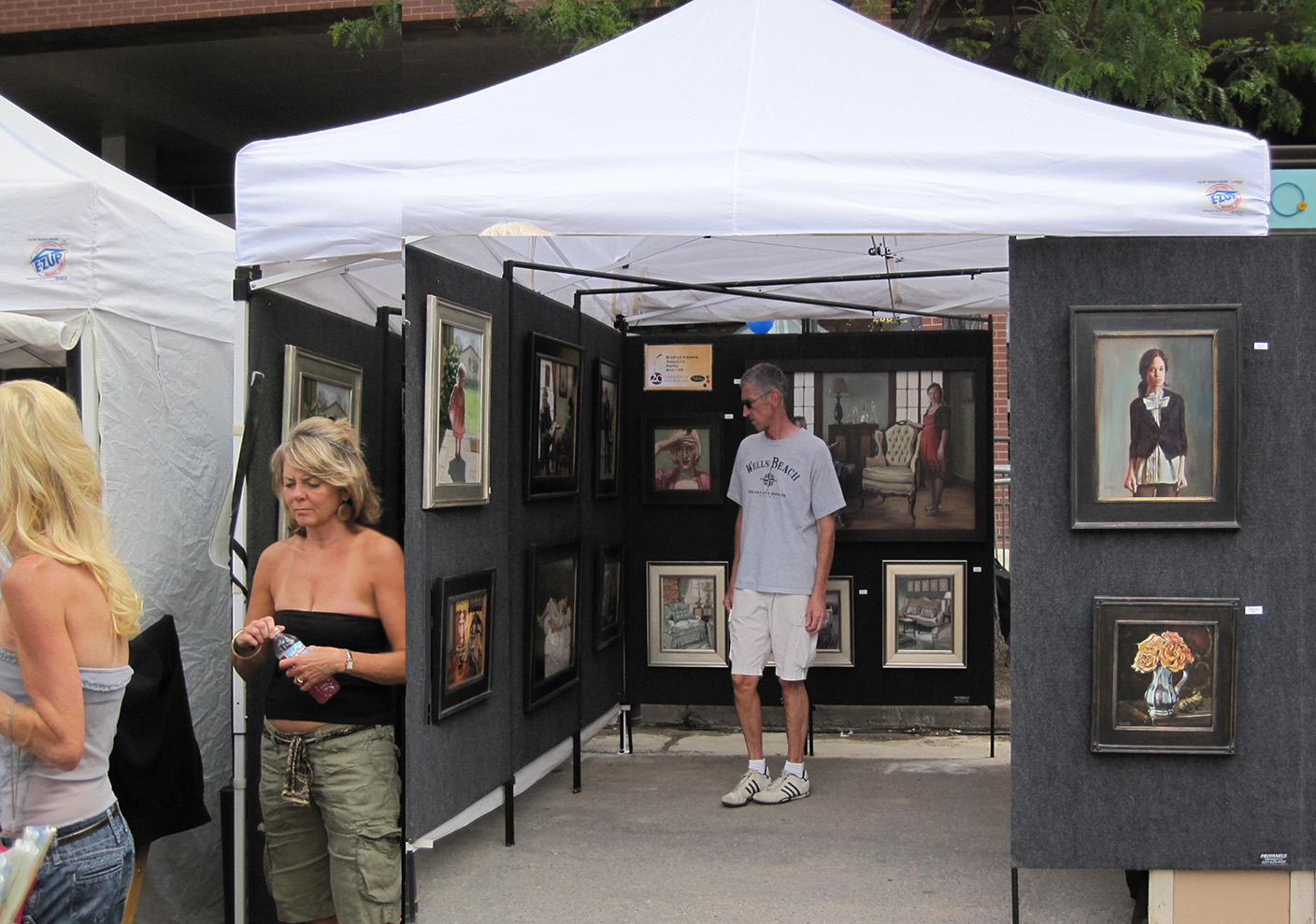
Bradford J. Salamon's booth at CCAF
Photograph by WCarbone
Another year has passed and another Cherry Creek Arts Festival is under way, another wave of artists and vendors. New art, old art, good art, better art but not much rain-art, at least not by 3:00 P.M. yesterday.
That is to say that it always rains opening day of the CCAF. We left around 3:00 and at that time it had not rained yet.
All n’ all it was a perfect day for an art festival and though I’ve only seen about half of the artists, I’ll add to the following list after the end of this day.
The paintings in the booth of Bradford J. Salamon of California (above) left a very strong impression. The luxuriously rich oils had a dessert-like icing-on-the-cake finish. Salamon’s impressionistic technique creates areas of photo-realism in paintings of gorgeous faces in salon-like settings.
Bow Tie - Bradford J. Salamon
Photograph from Bradford J. Salamon's website
Vibrant, glossy colors meld into backgrounds of muted browns and golds, at least that’s what’s stuck in my memory.
Waiting in White - Bradford J. Salamon
Photograph from Bradford J. Salamon's website
Salamon is a big guy. You’d guess football player rather than painter of fine oils. Find out more about him from his website: Bradford J. Salamon’s Official Website
Other work that I really enjoyed, not necessarily in any particular order include paintings by Loretta Petraitis who paints rust and stuff in city-scapes of rusted bridges with rivets, bolts and other industrial trapings. Hard, cold realism is nailed and riveted to the canvas. [This is too esotaric, but “all molecules have equal value.”] Loretta Petraitis works can be seen on the web here
Cézanne inspired (I’m sure) oils in oranges and yellows, of oranges and yellows, that’s lemons and oranges to the little people, are executed beautifully by Kelley Somer of Alpine Utah. The colorful, yet stark oils are powerfully vibrant – some suggestive of those chewey, sugar-coated-citrus candy wedges. Glass vessels and silver utensils complement the fruits (in contrast.) Kelly Somer’s work can be seen on her website www.kellysomer.com
Thomas Wargin must have ridden down Hell’s main highway on a motorcycle in order to be able to conjure up the images, in sculpture, of his wild cycle-creatures: part human – part machine, rolling down a road of imagination. Other Bosch-like sculpture includes two (fused) topless women sharing a dress of golden breasts. Thomas Wargin’s website is choc full of sculpture.
These are just a few of the artists that really engaged me. They as well as many other artists can be found on the CCAF website.
I know this is pretentious, it’s just my opinion. You can also have an opinion.
Monday July 5, 2010
Well I went back to the show; it was pretty much rained out last night. Today was a beautiful sunshiny day. I went back but didn’t really find anything that knocked me out. Maybe one or two of the following.
I’m still trying to figure out the “Best of Show.” Best I can figure is that it’s an entire installation piece that won “Best of Show” – in the “Painting” catagory. It’s a hand crafted shipping-crate-type structure (98″ x 78″ x 113″) which is like a little gallery with framed paintings on the walls. Here’s the link, you go figure it out: www.joachimknill.com/national-treasure/crate.html Maybe it could be a dwelling for a homeless family. They would need Street Supplies.
by *Adobe Moon In The City Poster
c.2010 LasVegasBuffetClub
The Moon will be 100% full June 26, 2010 at 4:31 A.M. Las Vegas time.
From Western Washington University:
“American Indians gave names to each of the full moons to keep track of the passing year. The names are associated with the entire month until the next full moon occurs. Since a lunar month averages 29 days, the dates of the moons change from year to year. Here are titles most closely associated with calendar months.”
Back East
In the Algonquin (Northeast to Great Lakes) language the name for the June full moon is: “twowa kesos” or “when they hill indian corn.” Algonquin Woman and Child
Out West
In the Zuni (Southwest, New Mexico) language the name for June’s full moon is: “ik’ohbu yachunne” or “turning moon.” Zuni Woman
“The full moon occurs when the Sun and Moon are located on opposite sides of the Earth. In this situation, the face of the Moon visible from the Earth is completely illuminated by the Sun. More specifically, the full moon occurs when the geocentric apparent longitudes of the Sun and the Moon are 180 degrees apart. This is a fancy way of saying that the Sun and the Moon are on opposite sides of the sky.” read more interesting moon facts from Universe Today
Partial Lunar Eclipse Coming On June 26 by Joe Rao
“Two weeks before a total eclipse of the sun crosses over the South Pacific Ocean, the moon will put on a sky show of its own — a partial lunar eclipse on June 26 that should be visible from parts of North America, weather permitting.”
“The lunar eclipse will occur in the early morning hours of Saturday, June 26 as the moon crosses through the southern portion of Earth’s shadow in the constellation Sagittarius. At least some of this interesting event will be visible from western and central North America” read more from Space.Com
The following paragraphs are from the US Memorial Day website:
Memorial Day, originally called Decoration Day, is a day of remembrance for those who have died in our nation’s service. There are many stories as to its actual beginnings, with over two dozen cities and towns laying claim to being the birthplace of Memorial Day. There is also evidence that organized women’s groups in the South were decorating graves before the end of the Civil War: a hymn published in 1867, “Kneel Where Our Loves are Sleeping” by Nella L. Sweet carried the dedication “To The Ladies of the South who are Decorating the Graves of the Confederate Dead” (Source: Duke University’s Historic American Sheet Music, 1850-1920). While Waterloo N.Y. was officially declared the birthplace of Memorial Day by President Lyndon Johnson in May 1966, it’s difficult to prove conclusively the origins of the day. It is more likely that it had many separate beginnings; each of those towns and every planned or spontaneous gathering of people to honor the war dead in the 1860’s tapped into the general human need to honor our dead, each contributed honorably to the growing movement that culminated in Gen Logan giving his official proclamation in 1868. It is not important who was the very first, what is important is that Memorial Day was established. Memorial Day is not about division. It is about reconciliation; it is about coming together to honor those who gave their all.
Memorial Day was officially proclaimed on 5 May 1868 by General John Logan, national commander of the Grand Army of the Republic, in his General Order No. 11, and was first observed on 30 May 1868, when flowers were placed on the graves of Union and Confederate soldiers at Arlington National Cemetery. The first state to officially recognize the holiday was New York in 1873. By 1890 it was recognized by all of the northern states. The South refused to acknowledge the day, honoring their dead on separate days until after World War I (when the holiday changed from honoring just those who died fighting in the Civil War to honoring Americans who died fighting in any war). It is now celebrated in almost every State on the last Monday in May (passed by Congress with the National Holiday Act of 1971 (P.L. 90 – 363) to ensure a three day weekend for Federal holidays), though several southern states have an additional separate day for honoring the Confederate war dead: January 19 in Texas, April 26 in Alabama, Florida, Georgia, and Mississippi; May 10 in South Carolina; and June 3 (Jefferson Davis’ birthday) in Louisiana and Tennessee read more Memorial Day History
The moon will be 100% full Thursday, May 27, 2010 at 4:07 P.M. Las Vegas, Nevada time.
“American Indians gave names to each of the full moons to keep track of the passing year. The names are associated with the entire month until the next full moon occurs. Since a lunar month averages 29 days, the dates of the moons change from year to year. Here are titles most closely associated with calendar months.” This paragraph is from Western Washington University
According to WWU: in the Cherokee (East Coast, Carolinas) language the May moon is “ansgvti” or “planting moon.” Cherokee Woman wearing Haute Couture
Western Washington University
The Shoshone (Great Basin, Nevada, Wyoming) name for the May moon is “buhisea’-mea'” or “budding.”
Shoshone Woman & Child
Western Washington University
Happy Mother’s Day, Moms, from the Las Vegas Buffet Club.
“The history of Mother’s Day is centuries old and goes back to the times of ancient Greeks, who held festivities to honor Rhea, the mother of the gods. The early Christians celebrated the Mother’s festival on the fourth Sunday of Lent to honor Mary, the mother of Christ. Interestingly, later on a religious order stretched the holiday to include all mothers, and named it as the Mothering Sunday. The English colonists settled in America discontinued the tradition of Mothering Sunday because of lack of time. In 1872 Julia Ward Howe organized a day for mothers dedicated to peace. It is a landmark in the history of Mother’s Day read more from dayformother’s.com
DayForMothers.Com has everything there is to know about Mother’s Day: history, facts, jokes, poems, gifts, etc. etc. etc…


 by
by