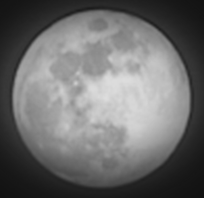
Time for another Full Moon! The moon will be 100% full August 5, 2009 at 5:56 P.M. Las Vegas time.
OUT WEST:
“American Indians gave names to each of the full moons to keep track of the passing year. The names are associated with the entire month until the next full moon occurs. Since a lunar month averages 29 days, the dates of the moons change from year to year. Here are titles most closely associated with calendar months” read more from The Western Washington University Planetarium Website
According to Western Washington University, The Comanche of the Southern Plains refer to this August (5th) Full Moon as: “tahma mua” or summer moon (click the WWU link above for more information.)
Back East:
“Historically the Native Americans who lived in the area that is now the northern and eastern United States kept track of the seasons by giving distinctive names to the recurring full Moons. Each full Moon name was applied to the entire month in which it occurred. These names, and some variations, were used by the Algonquin tribes from New England to Lake Superior.” read more from The Old Farmer’s Almanac
“The full Moon name for this month is Full Sturgeon Moon. Some Native American tribes knew that the sturgeon of the Great Lakes and Lake Champlain were most readily caught during this full Moon. Others called it the Green Corn Moon or the Grain Moon.”
Astrologically speaking:
Full Moon in Aquarius, By Molly Hall at About.com
“This year’s Aquarius Full Moon is on August 5/6, depending on your time zone, and is preceded by a penumbral (partial) lunar eclipse. The lunar eclipse is exact August 5th, at 8:39 pm EDT, with the full Moon exact at 8:55 pm EDT.” read more from Molly Hall at About.com
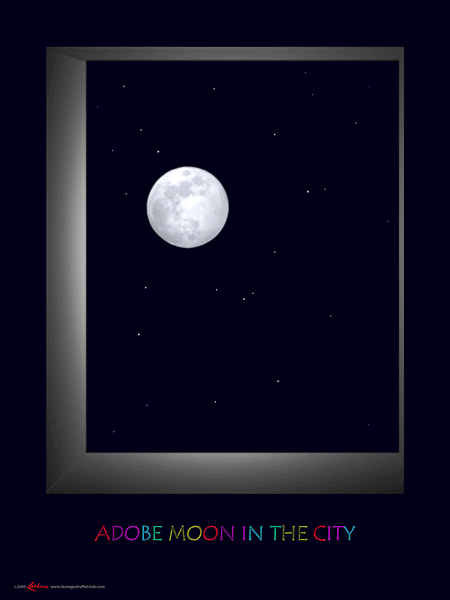
The [c.2009-Adobe Moon in the City] poster is available for purchase. The full moon in this poster was photographed in Las Vegas in the 90s. The image was inserted into it’s “frame” with a Photoshop type application. The poster is 24″x36″.
by David Yeagley is the great-great-grandson
of Comanche leader Bad Eagle.
This post is a re-e-print of a July 12, 2009 article by *David Yeagley of BAD EAGLE.COM.
Although this elegant material may be a bit esoteric for these pages, the concept might penetrate and remain. [BC]
“In The Laws, Plato’s character, the Athenian, claims that bad quality music corrupted the democracy of Athens. If this work was written ca. 350 BC, then the commentary is curious. Alexander the Great, of course, came on the scene in 336 BC. This would mean that, at least in Plato’s view, the city state democracy of Athens was long foiled. But what of that? Why would Plato theorize that it was the quality of music that destroyed the democracy? And what difference did that actually make? It certainly didn’t deter the empire.”
“In Book III of The Laws, Plato’s Athenian said it started with a breach of public manners. Educated people behaved during concerts. Then bad music started being performed, and audiences responded with a lack of decor. It was the erosion of public manners and social graces–caused or inspired by the vulgar quality of music. One think led to another. It seems that the artists, the composers in particular, were to blame. And it seems the poor or bad (immoral) quality of the music was the result of mixing styles.”
“From the Jowett translation:”
“And then, as time went on, the poets themselves introduced the reign of vulgar and lawless innovation. They were men of genius, but they had no perception of what is just and lawful in music; raging like Bacchanals and possessed with inordinate delights-mingling lamentations with hymns, and paeans with dithyrambs; imitating the sounds of the flute on the lyre, and making one general confusion; ignorantly affirming that music has no truth, and, whether good or bad, can only be judged of rightly by the pleasure of the hearer. And by composing such licentious works, and adding to them words as licentious, they have inspired the multitude with lawlessness and boldness, and made them fancy that they can judge for themselves about melody and song.”
“The Trevor J. Saunders translation says the composers were “gripped by a frenzied and excessive lust for pleasure,” and that was the motivation for the mix.”
“Jowett:”
“For if the democracy which judged had only consisted of educated persons, no fatal harm would have been done; but in music there first arose the universal conceit of omniscience and general lawlessness;-freedom came following afterwards, and men, fancying that they knew what they did not know, had no longer any fear, and the absence of fear begets shamelessness. For what is this shamelessness, which is so evil a thing, but the insolent refusal to regard the opinion of the better by reason of an over-daring sort of liberty?”
“Heavy thought here. Very heavy. And then Plato’s Athenian comments on the social effects of such lawlessness in music, where the common people rule:”
“Consequent upon this freedom comes the other freedom, of disobedience to rulers; and then the attempt to escape the control and exhortation of father, mother, elders, and when near the end, the control of the laws also; and at the very end there is the contempt of oaths and pledges, and no regard at all for the Gods-herein they exhibit and imitate the old so called Titanic nature, and come to the same point as the Titans when they rebelled against God, leading a life of endless evils. ”
“These things are of course all subject to interpretation, both historically, as well as philosophically and sociologically. But, it is difficult not to draw immediate parallels in our modern Western society.”
“In the history of Western music, there has always been a distinction between good and bad music, sacred and secular, and classical and popular, shall we say. Lyrics have always been a key indicator of the quality and effect of the music. Secular lyrics have always tended to be about romance, courtship, and the like. Sexual love, to put it plainly. This music, however exciting or pleasurable, was never known to elevate the soul or to encourage spirituality.”
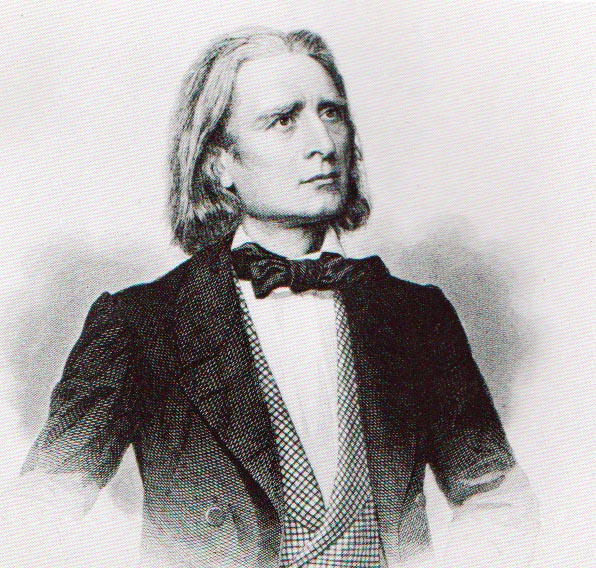
“I must say, this distinction between the sacred and the secular has been the one pursuit of my entire academic life. The issue was consciously focused in me at the age of sixteen. I pursued this topic through my years at Oberlin Conservatory, at Yale Divinity, at Emory University, and it finally became the topic of my doctoral thesis at the University of Arizona in 1994. My thesis was on a piano composition by Franz Liszt, The Dante Sonata”
Hungarian Franz Liszt, 1811-1886
“All these many years I attempted to determine what was “religious” about religious music. What was irreligious or secular about non-religious music. Could it be nailed down to a note? Such a pursuit was not programmed in any degree layout. I was on my own in this quest. This is the reason I ended up with such a broad background, including parts of literature, history, biblical studies, psychology, philosophy, and political theory. I looked into the classical Greek social commentary of Plato and Aristotle (et al.) to see how they defined music. It was strictly by its effect they defined it. Its effect on humans. It was a social activity, essentially.”
“At any rate, I came early to the conclusion that music had meaning via association. “Who put the spook into the bass clarinet?” I asked. “Whoever first conceived of the spook,” I answered my own question, in a bit of a Platonic dialogue style.”
“Religious music is chiefly so due to the religious sentiments preexisting in the composer and his listners. I cannot say that irreligious or non-religious music encourages religious sentiment. It is for a different purpose. Yet, I cannot say religious music guarantees a religious experience. At best, it can only suggest it, only encourage it, or provide a venue for it. Religion is religion. Music is music. Music is a mirror, or an expression. Not an alien power that wields its own world. It is first the composer’s or performer’s expression of his emotions or values; then it ignites the same in the listeners.”
“In America, today, we have the market. The free-enterprise approach to everything–even down to the nail polish on the woman’s toes. We have incalculable variety of music. We have an interminable mix in our society. Plato would probably suggest that we have corrupted our democracy, entirely. Absolute freedom is chaos, or anarchy. Not the way society survives.”
*David Yeagley is the great-great-grandson of Comanche leader Bad Eagle. Read more…
P.S.
I was immediately drawn to the above article. Although my limited education in this area is **mostly, self-aquired, I can still reap tangible benifits from it. On a lessor level, I acquired some musical knowledge in garage and garden-party bands in the 50s & 60s, and in Hollywood recording studios in the 70s. On a higher level, the most profound expierience was studying Classical Guitar and becoming fairly proficient playing ***compositions, such as: JS Bach’s “Lute Prelude in D Minor.” As well as pieces by Mozart, Fenando Sor, Matteo Carcassi, Ferdinando Carulli and others. This dual perspective seems to give me enough fodder to understand the gist of: “Plato: Bad Music Destroys Democracy.” [BC]
P.S.S.
I met the great, great grandson of the Apache leader, Geronimo.
**Took master-classes from John Harrison.
***[Music] “known to elevate the soul or to encourage spirituality” (from the above post)
“He rocks in the tree-top all a day long
Hoppin’ and a-boppin’ and a-singin’ the song
All the little birds on J-Bird St.
Love to hear the robin goin’ tweet tweet tweet”
“Rockin’ Robin is a 1958 song by Bobby Day. The single was Day’s only hit single, becoming a No. 2 Billboard Hot 100 hit. The song was covered by The Hollies on their first album in 1964 and would be revived as a single again in 1972 by the teenaged Michael Jackson as his second single release on Motown. Jackson took his version to number two on the U.S. pop singles chart that year” read more on Wikipedia
Adding my input to the Twitter landslide, this must be the definitive song for Twitterers: Bobby Day’s 1958 hit “Rockin’ Robin.” The word “tweet” is used 24 times, that’s two dozen tweets.
If anyone can show me a song with more than two dozen “tweets,” I’ll give them a nice prize.
“An important cog in Los Angeles’ doo wop community during the ’50s, Bobby Day wrote three often-covered early rock classics in 1957-1958. Day was part of the Hollywood Flames, one of the area’s top R&B vocal groups, and briefly part of Bob & Earl, later to hit without Day on “Harlem Shuffle.” Day formed his own group, the Satellites, in 1957, cutting the original “Little Bitty Pretty One” for Class Records. A nearly identical cover by Thurston Harris beat the original out, so Day countered with the driving “Rockin’ Robin” in 1958, an R&B chart-topper. Its flip, “Over and Over,” was a hit in its own right, although the Dave Clark Five’s 1965 revival is better remembered today. Day waxed a few more hits for Class in 1959, including “That’s All I Want” and a derivative “The Bluebird, the Buzzard & the Oriole,” flitting from label to label during the ’60s.” ~ Bill Dahl, All Music Guide [This info is from JohnB1948Two’s YouTube channel.]
The fine clockwork, drum work on Rockin’ Robin is by Earl Palmer.
“Earl Cyril Palmer (October 25, 1924 – September 19, 2008)[1] was an American drummer and member of the Rock and Roll Hall of Fame.”
“Palmer played on many recording sessions, including Little Richard’s first several albums and Tom Waits’ 1978 album Blue Valentine. According to one obituary, “his list of credits read like a Who’s Who of American popular music of the last 60 years” more from Wikipedia
…click for larger image *This is the “Adobe Moon in the City” poster.
The “FULL BUCK MOON” will be 100% full at 2:22 a.m. July 7, 2009, Las Vegas time.
OUT WEST
“American Indians gave names to each of the full moons to keep track of the passing year. The names are associated with the entire month until the next full moon occurs. Since a lunar month averages 29 days, the dates of the moons change from year to year. Here are titles most closely associated with calendar months” read more from The Western Washington University Planetarium Website
In the Zuni language, the name for The July [7] Moon is: “dayamcho yachunne” (“when limbs of trees are broken by fruit.”)
“Historically the Native Americans who lived in the area that is now the northern and eastern United States kept track of the seasons by giving distinctive names to the recurring full Moons. Each full Moon name was applied to the entire month in which it occurred. These names, and some variations, were used by the Algonquin tribes from New England to Lake Superior.” read more from The Old Farmer’s Almanac
The Full Buck Moon “The full Moon name for this month is Full Buck Moon. Bucks begin to grow new antlers at this time. This full Moon was also known as the Thunder Moon, because thunderstorms are so frequent during this month.”
[Both of the above sites seem to disagree on the official moon names. Just pick one!]
“Here is the chart for the Full Moon in Capricorn, exact on July 7th at 5:21 am EDT, followed by a penumbral (partial) lunar eclipse at 5:38 am EDT.” read more from About.com… This is an insightful perspective from an astrologer. [Variances in FM times are due to geographical differences.]
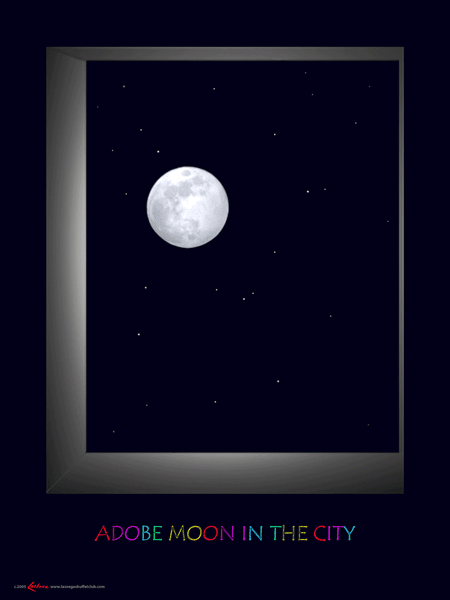
*The [c.2009-Adobe Moon in the City] poster is available for purchase. The full moon in this poster was photographed in Las Vegas in the 90s. The image was inserted into it’s “frame” with a Photoshop type application. The poster is 24″x36″.
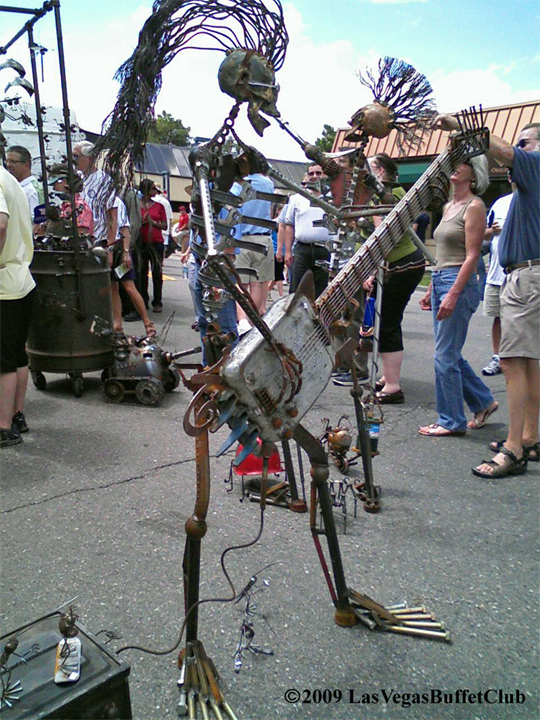
This Heavy Metal Dead Head (metal and steel) was welded from pieces of steel, metal, nuts and bolts, tools and other misc. pieces by Fred Conlon / Sugar Post (see below.)
[ Photograph is reproduced with permission of the artist. ]
19th Annual Cherry Creek Arts Festival July 3, 4, 5, 2009 Denver, Colorado, USA
I attended the 2009 Cherry Creek Art Festival on July 3rd and 4th. The show got rained out, AGAIN……………..on the 3rd.
No, I don’t know everything, however, I know what I like. I like the following artists’ work (not in any particular order.)
The following links will take you to the CCAF page (click on the artist’s name for information and an example of their work,) and a website or page with information about the artist:
The Shady Lady Ranch is looking for a few “good men” to work as male p———s in it’s brothel, half-way between Goldfield, Nevada and Beatty, Nevada. Located on Highway 95, 31 miles North of Beatty, Nevada (around 150 miles north of Las Vegas,) the Shady Lady Ranch is trying to enact their own stimulis package to bring in sorely needed revenue..The male p———s will be in service for the “Janes” (female customers) who patronize the ranch.
Former “Hollywood Madam” Heidi Fleiss was attempting to open “Heidi’s Stud Farm” near Pahrump, Nevada when that plan was waylayed by Fleiss’ arrest on Felony drug charges earlier this year. Shady Lady becomes the latest torch-bearer, turning-the-screw one more revolution toward the reality of hiring males to work in brothels.
From the LA Times’ Movable Buffet: “Also, Shady Lady is offering the Las Vegas Sun price quotes: “The minimum would be two hours, probably at a cost of $500, she said. Three hours would cost $700 and four hours, $1,000. An overnight stay would be $2,000.” This is interesting because traditional brothel p——–s in Nye Country are all independent contractors who set their own rates that are only required to exceed a house minimum.”
Nevada brothels are feeling the effects of the economy along with Las Vegas and the rest of the country. Desperate times call for desperate measures. Like the current $25 all-day buffet deal at the Excalibur Hotel, gas rebates and hotel room deals in Las Vegas, this might be a quick-fix or a boner of an idea. Time will tell.
Although illegal in the metro areas of Las Vegas and Reno, p———n is legal in several Nevada counties, including Nye County where the Shady Lady Ranch is located.
Richard Abowitz from the Movable Buffet writes: “This particular brothel sits more than 100 miles north of Las Vegas. But if the Shady Lady gets the law changed for Nye County, that would apply to the brothels that sit closer to Vegas just over the Clark County line.”
[Certain words have necessarily been omited because of Googles Advertising policies]
The Full Strawberry Moon will be 100% full on June 7, 2009 at 11:12 A.M., Las Vegas time.
BACK EAST
“Historically the Native Americans who lived in the area that is now the northern and eastern United States kept track of the seasons by giving distinctive names to the recurring full Moons. Each full Moon name was applied to the entire month in which it occurred. These names, and some variations, were used by the Algonquin tribes from New England to Lake Superior” read more from The Old Farmer’s Almanac…
*FULL STRAWBERRY MOON “The Algonquin tribes knew this Moon as a time to gather ripening strawberries. It is also known as the Rose Moon and the Hot Moon.”
OUT WEST
“American Indians gave names to each of the full moons to keep track of the passing year. The names are associated with the entire month until the next full moon occurs. Since a lunar month averages 29 days, the dates of the moons change from year to year. Here are titles most closely associated with calendar months” read more…
(From the) Zuni Tribe of Southwest, New Mexico: The name of June’s Full Moon: “ik’ohbu yachunne” or “turning moon.”


 by
by