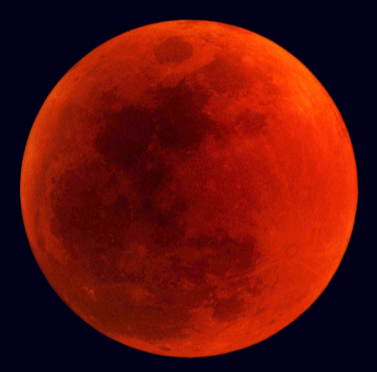
The Full Strawberry Moon will be on Monday – June 20, 2016 at 4:04 A.M. Pacific Time
From Almanac.com
The month of June’s Full Moon’s name is the Full Strawberry Moon. June’s Full Strawberry Moon got its name because the Algonquin tribes knew it as a signal to gather ripening fruit. It was often known as the Full Rose Moon in Europe (where strawberries aren’t native) and the Honey Moon. See ALL Full Moon names and their meanings.From Almanac.com
*
Watch Almanac.Com Video on June’s Full Strawberry Moon
With Amy Nieskens
FULL MOON FOR JUNE RISES ON THE SUMMER SOLSTICE!
“This June, 2016, the solstice and full Moon coincide—a rare event, indeed, that hasn’t happened in nearly 70 years. The event will be broadcast LIVE from Slooh’s observatory in the Canary Islands, and Almanac editors will co-host the event. Click here to see the Full Moon Summer Solstice show for free.”
Farmers Almanac.com
by Joe Rao | Monday, September 14th, 2015 | From: Astronomy
On Sunday night, September 27th, for the fourth time in the last 17 months, the Moon will once again become completely immersed in the Earth’s shadow, resulting in a total lunar eclipse.
As is the case with all lunar eclipses, the region of visibility will encompass more than half of our planet. Nearly a billion people in the Western Hemisphere, nearly a billion and a half for much of Europe and Africa, and perhaps another half billion in Western Asia, will be able to watch as the full Harvest Moon becomes a shadow of its former self and morphs into a glowing coppery ball.
It will also be the biggest full Moon of 2015, since on the very same day, the Moon will also be at perigee — its closest point to the Earth at 221,753 miles (356,877 km) — making it a so-called “supermoon.” Continue reading →
The month of June’s full Moon’s name is the Full Strawberry Moon. June’s Full Strawberry Moon got its name because the Algonquin tribes knew it as a signal to gather ripening fruit.
It was often known as the Full Rose Moon in Europe (where strawberries aren’t native).
There will be another Full Moon, October 8, 2014 at 3:50 A.M. Las Vegas time.
From The Old Farmer’s Almanac
“In 2014, the Full Moon falls on October 8—and there is a total lunar eclipse.”
“The eclipse will be fully visible from Western North America (and Alaska and Hawaii), but observers in Eastern North America will only be able to see part of the eclipse before the Moon sets below the horizon. See more details on our Eclipse page.”
“Some Native American tribes referred to this Moon as the Full Hunter’s Moon, as it was the time to go hunting in preparation for winter. This full Moon is also called the Travel Moon and the Dying Grass Moon.”
“This is the first Full Moon following the Harvest Moon last month. It rises around sunset and sets around sunrise, the only night in the month when the Moon is in the sky all night long.”
Full Hunter’s Moon Video from Old Farmer’s Almanac
Full Moon
From The Old Farmer’s Almanac
“Supermoon” of August 10, 2014
This Sunday, August 10, the full Moon will appear as much as 14% closer and 30% brighter than other full Moons of the year. Read more
The Old Farmer’s Almanac: August’s Video featuring Amy Nieskens
“Each month, we will explain the traditional names of the full Moon along with some fascinating Moon facts. In this video, learn about the Full Sturgeon Moon and why you can sometimes see the Moon during the daytime.”
Full Sturgeon Moon
Some Native American tribes called this month’s Moon the Sturgeon Moon because they knew that the sturgeon of the Great Lakes and Lake Champlain were most readily caught during this full Moon. They also called this the Full Green Corn Moon.
Different tribes had different Moon name preferences. Other examples for August are: Wheat Cut Moon (San Ildefonso, and San Juan), or “Moon When All Things Ripen” (Dakotah Sioux) or “Blueberry Moon” (Ojibway).
The Snow Moon will be 100% full February 14, 2014 at 4:54 P.M. Mountain time.
The following information is from The Old Farmer’s Almanac
Full Moon Names
February’s full Moon is traditionally called the Full Snow Moon because usually the heaviest snows fall in February.
Hunting becomes very difficult, and so some Native American tribes called this the Hunger Moon.
Other Native American tribes called this Moon the “Shoulder to Shoulder Around the Fire Moon” (Wishram Native Americans), the “No Snow in the Trails Moon” (Zuni Native Americans), and the “Bone Moon” (Cherokee Native Americans). The Bone Moon meant that there was so little food that people gnawed on bones and ate bone marrow soup.
Farmer’s Almanac’s Full Moon Video featuring, Amy Nieskens
“Each month, we will explain the traditional names of the full Moon along with some fascinating Moon facts. In this video, learn about February’s Full Snow Moon. Click below to watch video.”
Why Native Americans Named the Moons
The early Native Americans did not record time by using the months of the Julian or Gregorian calendar. Many tribes kept track of time by observing the seasons and lunar months, although there was much variability. For some tribes, the year contained 4 seasons and started at a certain season, such as spring or fall. Others counted 5 seasons to a year. Some tribes defined a year as 12 Moons, while others assigned it 13. Certain tribes that used the lunar calendar added an extra Moon every few years, to keep it in sync with the seasons.
Each tribe that did name the full Moons (and/or lunar months) had its own naming preferences. Some would use 12 names for the year while others might use 5, 6, or 7; also, certain names might change the next year. A full Moon name used by one tribe might differ from one used by another tribe for the same time period, or be the same name but represent a different time period. The name itself was often a description relating to a particular activity/event that usually occurred during that time in their location. read more from The Old Farmer’s Almanac
This is a Moon video from The Old Farmer’s Almanac
“November’s full Moon was called the Beaver Moon because it was the time to set traps, before the waters froze over. This Moon was also called the Full Frost Moon.”
Full Beaver Moon – November 17th at 7:16 A.M. Las Vegas Time
The following video, featuring Amy Nieskens, is from The Old Farmer’s Almanac
The Moon will be 100% full October 18, 2013 at 4:37 P.M. Las Vegas time.
From The Old Farmer’s Almanac
Some Native American tribes referred to this Moon as the Full Hunter’s Moon, as it was the time to go hunting in preparation for winter.
It rises around sunset and sets around sunrise, the only night in the month when the Moon is in the sky all night long.
This full Moon is also called the Travel Moon and the Dying Grass Moon.
From The Huffington Post The Huffington Post | By Sara Gates | Posted: 10/16/13 EDT
Penumbral Lunar Eclipse 2013: Earth’s Shadow To Fall On Full Moon On Friday, Oct. 18
October’s full moon has a bonus in store for skywatchers this year.
A penumbral lunar eclipse — so called because only the incomplete outer portion of the Earth’s shadow, or penumbra, falls across the moon — is expected to reach its deepest point at 7:50 p.m. ET on Friday, Oct. 18.
Unlike total eclipses, in which Earth’s umbra — the central region of its shadow — darkens the moon entirely, a penumbral lunar eclipse involves only a slight dimming. Skywatchers should expect to see a much more subtle sight — with a shadow on the lower half of the full moon — like the eclipse pictured below. More from The Huffpost.


 by
by